
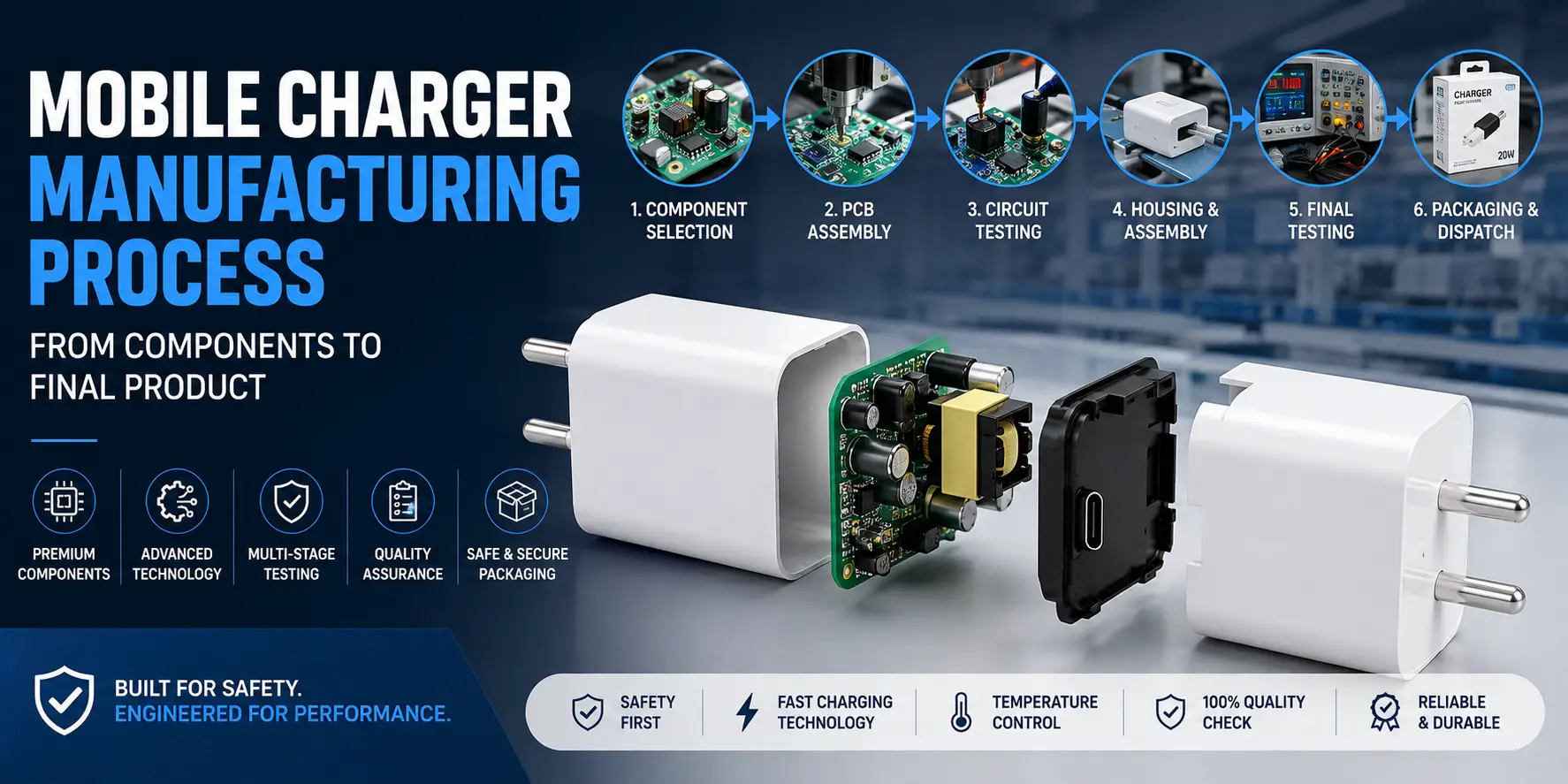
Mobile chargers may look like simple everyday products, but the manufacturing process behind them involves multiple stages of engineering, component selection, assembly, testing and quality control. From a standard wall charger to a modern fast charger supporting technologies such as PD and QC, every product needs to deliver stable performance while meeting the required safety and quality expectations.
For brands entering the mobile accessories market, understanding the mobile charger manufacturing process is useful when selecting products, developing specifications, or choosing the right manufacturing partner. The process is not limited to assembling components inside a plastic housing. Product performance depends on how those components are selected, integrated, tested and evaluated throughout production.
This guide explains how mobile chargers are manufactured, from the initial selection of components to final inspection and packaging.
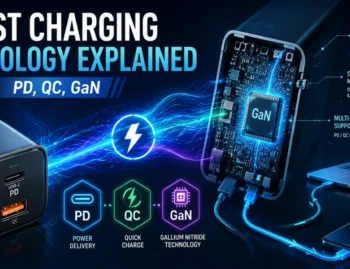
Also Read: Fast Charging Technology Explained for Brands (PD, QC, GaN)
Understanding the Basics of Mobile Charger Manufacturing
The exact manufacturing process can vary depending on the type of charger being produced. A basic charger and a high-power fast charger may have different circuit designs, components, testing requirements and production processes.
Some common charger categories include:
- Standard wall chargers
- Fast chargers
- USB Type-C chargers
- PD chargers
- QC chargers
- Multi-port chargers
- GaN chargers
Despite these differences, the overall manufacturing journey follows a similar structure. The process usually begins with product specifications and component selection, followed by PCB assembly, functional testing, final assembly, quality inspection and packaging.
A reliable mobile charger manufacturer focuses on consistency throughout each of these stages because even a small issue in a component or connection can affect the performance of the final product.
Step 1: Defining the Charger Specifications
Before manufacturing begins, the product requirements need to be clearly defined.
The specifications may include:
- Input voltage
- Output voltage
- Output current
- Maximum power rating
- Number and type of charging ports
- Supported charging protocols
- Product dimensions
- Housing material
- Plug configuration
- Target market requirements
For example, a 20W Type-C PD charger requires a different technical configuration from a 65W multi-port charger.
Clear specifications help manufacturers select suitable components and develop a production process around the intended product performance.
For brands working with an OEM partner, this stage is also important for deciding whether the product will use an existing design or require specific customization.
Step 2: Selecting the Right Components
Component selection has a direct impact on charger performance, reliability, and long-term consistency.
A typical mobile charger contains several key electronic and mechanical components, including:
- Printed Circuit Board or PCB
- Transformer
- Capacitors
- Resistors
- Integrated Circuits
- Rectifiers
- Connectors
- USB ports
- Thermal protection components
- Plastic or flame-resistant housing
The quality and compatibility of these components influence how efficiently the charger converts and delivers power.
For fast chargers, the charging controller and supporting components also need to work correctly with the intended charging protocol. This is why component selection should be based on product specifications rather than simply choosing the lowest-cost option.
A well-planned component selection process helps maintain consistency across production batches and reduces the possibility of performance variation.
Step 3: PCB Assembly
The Printed Circuit Board is one of the most important parts of a mobile charger. It acts as the platform that connects and supports the electronic components responsible for power conversion and regulation.
During PCB assembly, components are placed and soldered according to the circuit design.
Depending on the product and production setup, the process may involve automated assembly systems and controlled soldering processes.
Key activities can include:
- Applying solder paste
- Mounting electronic components
- Soldering
- Component placement inspection
- PCB cleaning
- Initial functional verification
Accurate component placement and reliable solder joints are essential because loose or incorrect connections can affect charger performance.
After assembly, the PCB is inspected before moving to the next stage of production.
Also Read: Inside the Mobile Accessories Manufacturing Process
Step 4: Circuit Testing and Functional Verification
Before the PCB is installed inside the charger housing, it needs to be tested for basic functionality.
This stage helps identify potential issues early in the manufacturing process.
Testing may include checking:
- Input and output performance
- Voltage stability
- Current delivery
- Circuit response
- Charging protocol communication
- Protection mechanisms
For fast chargers, testing is particularly important because the product may need to communicate with compatible devices and deliver different power levels based on the charging requirement.
Early functional testing helps prevent defective circuit boards from moving into final assembly.
Step 5: Fast Charging Technology Integration
Modern mobile chargers often support technologies such as Power Delivery (PD) and Quick Charge (QC).
These technologies require the charger to manage power delivery based on the capabilities and requirements of the connected device.
During the manufacturing and testing process, the charging circuit is evaluated to confirm that the intended charging protocols function correctly.
Depending on the charger design, testing may involve:
- Protocol compatibility checks
- Output power verification
- Voltage transition testing
- Current stability checks
- Temperature monitoring during operation
A charger should not simply deliver maximum power continuously. It needs to manage power safely according to the supported design and charging protocol.
This is why fast charger manufacturing requires careful coordination between circuit design, components, firmware where applicable, and product testing.
Step 6: Charger Housing and Final Assembly
Once the electronic assembly has passed the required checks, the PCB and other internal components are installed inside the charger housing.
The housing serves several purposes. It protects the internal electronics, provides structural strength, and helps create the final appearance of the product.
The assembly process may include:
- Positioning the PCB
- Installing the charging port
- Securing internal components
- Connecting plug components
- Closing the outer housing
- Checking physical alignment
The final product must be assembled carefully to ensure that internal components remain stable during regular use.
For private label and OEM projects, this stage may also involve customization of the product appearance, color, surface finish, branding, and packaging.
Step 7: In-Process Quality Checks
Quality control is not limited to the end of the production line.
During charger manufacturing, in-process inspections help identify issues before they affect a larger number of units.
Quality teams may check:
- Component placement
- Soldering quality
- PCB condition
- Housing alignment
- Port positioning
- Product appearance
- Basic functionality
Identifying problems during production helps reduce unnecessary rework and supports more consistent output.
For a mobile charger manufacturing company, maintaining quality checks at different stages is an important part of delivering reliable products at scale.
Also Read: Inside the Mobile Accessories Manufacturing Process
How SigmaVizin Supports Mobile Charger Manufacturing
For brands looking to develop or expand their charger portfolio, the manufacturing partner plays an important role throughout the product journey.
SigmaVizin supports mobile charger manufacturing for businesses looking for reliable production, product customization, private label opportunities and scalable manufacturing solutions.
The process begins with understanding the product requirements and continues through component selection, production, testing, final inspection, and packaging. Depending on the project, brands may also require customization in areas such as product specifications, charging capacity, design, branding and packaging.
A structured manufacturing approach helps businesses maintain greater consistency as they introduce new products or expand existing product lines.
Also Read:How to Start a Mobile Accessories Brand in India
What Comes Next in the Manufacturing Process?
PCB assembly and final product construction are only part of the journey. Before a charger is ready for the market, it must go through performance evaluation, electrical safety checks, temperature testing, final inspection and packaging verification. These final stages play an important role in ensuring that the finished product performs consistently before it reaches the customer.