
Power banks have become an essential mobile accessory for consumers who need reliable portable power throughout the day. From compact everyday power banks to high-capacity models with fast charging and wireless charging capabilities, these products combine battery technology, electronic circuits, safety systems and durable enclosures into one compact device.
For brands entering the mobile accessories market, understanding the power bank manufacturing process can help them make better decisions about product specifications, components, quality, and manufacturing partners.
A professional power bank manufacturer does much more than place a battery inside a plastic enclosure. The manufacturing process involves component selection, circuit assembly, battery integration, testing, safety verification, final assembly, and quality inspection.
This guide explains how a power bank moves from individual components to a finished product ready for packaging and distribution.
What Is a Power Bank?
A power bank is a portable energy-storage device designed to charge electronic devices when access to a conventional power source is limited.
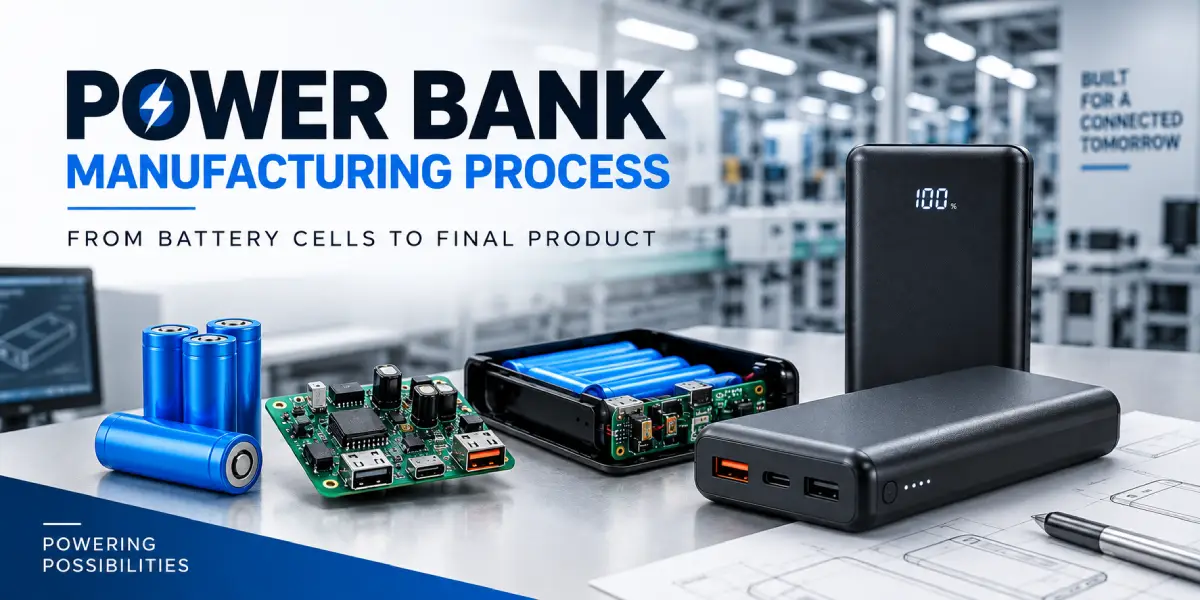
A typical power bank consists of several major components:
- Rechargeable battery cells
- Printed Circuit Board (PCB)
- Charging and power-management ICs
- Protection circuits
- USB or USB Type-C ports
- Connectors
- Housing or enclosure
- Indicators or display
- Internal wiring and supporting components
Each component has a specific role. The battery stores energy, while the PCB manages how that energy is received, stored and delivered to connected devices.
Modern power banks may also include additional features such as:
- Fast charging
- USB Power Delivery (PD)
- Multiple output ports
- Wireless charging
- LED displays
- Magnetic charging
- Multiple protection systems
The final design determines the components and manufacturing process required.
Also Read: Leading Power Bank Manufacturing in India
Step 1: Defining the Product Specifications
Before production begins, the brand and manufacturer need to establish clear product specifications.
These specifications define what the finished power bank is expected to do.
Important specifications can include:
- Battery capacity
- Input power
- Output power
- Charging technology
- Number of ports
- Wireless charging capability
- Product dimensions
- Weight
- Housing design
- Display or indicator requirements
For example, a compact power bank designed for everyday smartphone use may have completely different requirements from a high-capacity model designed for tablets or multiple devices.
Clear specifications help manufacturers select appropriate components and establish the right production process from the beginning.
For OEM and private-label projects, this stage may also include decisions about product appearance, branding, packaging, and customized features.
Step 2: Battery Cell Selection
The battery is the core energy-storage component of a power bank.
Battery cells must be selected according to the intended capacity, dimensions, discharge requirements, product design, and applicable safety considerations.
Depending on the product design, manufacturers may use different cell configurations and battery formats.
During incoming inspection, battery cells can be checked for factors such as:
- Physical condition
- Dimensions
- Rated specifications
- Voltage characteristics
- Capacity consistency
- Batch information
Consistency between cells is particularly important for products using multiple cells.
Poor-quality or inconsistent cells can negatively affect product performance and reliability, which is why battery selection is one of the most important stages in the manufacturing process.
Step 3: PCB and Power Management Circuit
The PCB controls the electrical operation of the power bank.
It manages functions such as charging the internal battery and delivering power to connected devices.
Depending on the design, the PCB may include:
- Charging IC
- Boost converter
- Protection IC
- USB controller
- Power management components
- Voltage regulation components
- Current monitoring components
For fast-charging power banks, the circuit design becomes more sophisticated because the product needs to manage higher power levels and communicate with compatible devices or charging protocols.
The PCB design must therefore match the intended product specifications.
Step 4: Protection Circuit Integration
Safety is a critical part of power bank manufacturing.
Because a power bank stores electrical energy in a rechargeable battery, appropriate protection systems are incorporated into the product design.
Depending on the product and applicable requirements, protection functions may address conditions such as:
- Overcharging
- Over-discharging
- Overcurrent
- Short circuit
- Abnormal temperature
- Excessive electrical conditions
The exact protection architecture depends on the battery chemistry, circuit design, product specifications, and applicable standards.
Protection systems are tested during the quality-control process to verify that the designed safeguards respond appropriately under defined test conditions.
Step 5: PCB Assembly
Once the circuit design and components are finalized, electronic components are assembled onto the PCB.
The process may involve automated component placement followed by soldering and inspection.
Typical stages include:
- Solder paste application
- Component placement
- Reflow soldering
- PCB inspection
- Functional verification
Accurate component placement is essential because even a small assembly defect can affect electrical performance.
After assembly, the PCB is inspected for issues such as poor solder joints, incorrect component placement, or visible damage.
Step 6: Battery and PCB Assembly
After the PCB has passed its initial checks, it is integrated with the battery system.
This stage requires controlled assembly because the battery and electronic circuit work together throughout the product’s operation.
Manufacturing teams carefully manage:
- Battery connections
- Insulation
- Wiring
- PCB positioning
- Protection components
- Internal mechanical support
The objective is to create a stable internal assembly that can withstand normal product handling while maintaining reliable electrical connections.
Step 7: Charging and Discharging Testing
Once the battery and PCB are integrated, the power bank can undergo functional testing.
Charging testing verifies how the internal battery receives energy from the input source.
Discharging testing evaluates how the stored energy is delivered to an external device.
Testing may examine:
- Input performance
- Output performance
- Voltage stability
- Current delivery
- Charging behavior
- Discharging behavior
- Power conversion performance
These checks help confirm that the finished circuit operates according to its intended specifications.
Step 8: Capacity Testing
The advertised capacity of a power bank is an important specification for customers.
Manufacturers therefore evaluate battery performance using controlled testing methods.
Capacity testing helps determine whether the battery system performs within the expected specification.
For brands, this is particularly important because inaccurate capacity claims can result in customer dissatisfaction and product returns.
A structured manufacturing process therefore includes appropriate capacity verification before the product is approved for final production.
Step 9: Fast Charging Testing
Modern power banks increasingly support fast charging technologies.
Depending on the product, this may include technologies such as USB Power Delivery or other supported charging protocols.
Fast charging testing can verify:
- Supported charging profiles
- Output power
- Voltage and current behavior
- Protocol communication
- Performance under different loads
- Temperature during operation
A power bank should deliver power according to its designed capabilities rather than simply maximizing output continuously.
Proper testing ensures that fast-charging functionality works as intended with compatible devices.
Also Read: Power Bank Manufacturing: How OEM Brands Can Lead the Portable Charging Market
Step 10: Temperature and Safety Testing
Temperature is an important consideration during power bank operation.
Both charging and discharging can generate heat, particularly in higher-power products.
Manufacturers monitor product temperature during controlled operating conditions to evaluate thermal performance.
Testing can help identify:
- Excessive heat
- Poor thermal management
- Abnormal circuit behavior
- Battery-related concerns
Thermal performance is evaluated alongside electrical and functional testing to provide a more complete picture of product reliability.
Step 11: Housing and Mechanical Assembly
Once the internal electronic system has passed the required checks, it is installed into the external housing.
The enclosure protects the internal components and gives the product its final appearance.
The assembly process may include:
- PCB positioning
- Battery placement
- Port alignment
- Display or LED installation
- Internal insulation
- Housing closure
- Screw or mechanical fastening
The finished enclosure should provide appropriate protection while maintaining a clean and professional appearance.
For private-label products, brands can also customize elements such as:
- Housing color
- Surface finish
- Product shape
- Logo placement
- Packaging
- Printed specifications
Step 12: Final Product Testing
After final assembly, the complete power bank undergoes final testing.
This stage checks the finished product rather than individual components.
Quality teams may verify:
- Charging function
- Output function
- Port operation
- Indicators
- Wireless charging, if applicable
- Physical condition
- Basic safety functions
- Product specifications
This final inspection helps identify problems that may only become visible after complete assembly.
Step 13: Quality Inspection
Quality inspection is one of the final checkpoints before products move toward packaging.
Inspectors review the product for both functional and visual consistency.
Typical checks include:
- Surface finish
- Housing alignment
- Port positioning
- Buttons
- Display or indicators
- Labels
- Product dimensions
- Functional performance
Products that do not meet the defined inspection criteria can be separated for further evaluation.
This helps maintain consistency across large production batches.
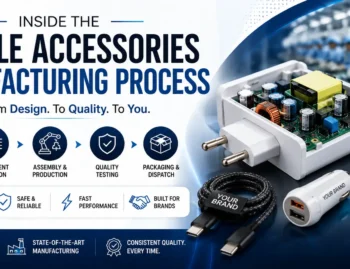
Also Read: Inside the Mobile Accessories Manufacturing Process
Step 14: Packaging and Dispatch
Once the products pass final inspection, they are prepared for packaging.
Packaging may include:
- Power bank
- Charging cable, where applicable
- User documentation
- Protective packaging
- Retail box
- Barcode or product labels
For private-label brands, packaging is often customized according to the brand’s requirements.
Before dispatch, the finished goods may undergo a final quantity and packaging verification to ensure the shipment matches the approved specifications.
How SigmaVizin Supports Power Bank Manufacturing
For brands looking to develop their own power bank range, selecting the right manufacturing partner can make a significant difference.
SigmaVizin supports businesses with mobile accessory manufacturing and private-label solutions, including power bank products designed around specific business and product requirements.
A structured manufacturing approach can support different stages of product development, from component selection and assembly to testing, quality inspection, customization and packaging.
For brands, this provides a more organized path from product concept to finished accessory.
The right manufacturing partner should not only provide production capacity but also understand the importance of consistency, product testing, quality control and scalable manufacturing.
Also Read: Power Up Your Business with India’s Leading Mobile Accessories Company
Why Quality Control Matters in Power Bank Manufacturing
Power banks combine battery technology with electronic power-management systems, so manufacturing quality is particularly important.
A strong quality-control process can help brands:
- Reduce manufacturing defects
- Improve product consistency
- Minimize customer complaints
- Reduce returns
- Maintain product specifications
- Build long-term customer trust
Quality should therefore be considered throughout the manufacturing process rather than only during final inspection.
What Brands Should Check Before Choosing a Power Bank Manufacturer
Before selecting a manufacturing partner, brands should evaluate more than production pricing.
Important questions include:
- What battery cells are used?
- How are incoming components inspected?
- What testing is performed during production?
- How is battery capacity verified?
- What safety protection systems are included?
- How are finished products inspected?
- Can the manufacturer support private-label customization?
- Can production scale with growing demand?
- How are product specifications maintained across batches?
A manufacturer that can clearly explain its production and quality processes is generally easier for a brand to evaluate and work with over the long term.
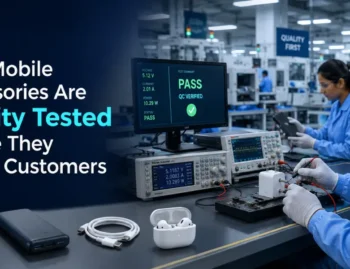
Also Read: How Mobile Accessories Are Quality Tested Before They Reach Customers
Final Thoughts
The power bank manufacturing process involves much more than assembling a battery and electronic circuit inside an enclosure.
From product specification and battery cell selection to PCB assembly, protection systems, capacity testing, fast-charging verification, thermal evaluation, final inspection, and packaging, every stage contributes to the performance and reliability of the finished product.
For brands, understanding these stages makes it easier to define product requirements and select an experienced manufacturing partner.
As the mobile accessories market continues to evolve, power banks are also becoming more advanced, with higher power outputs, faster charging, compact designs, wireless functionality, and smarter power-management systems.
A well-structured manufacturing process helps brands bring these products to market with greater consistency and confidence.
Frequently Asked Questions
1. What is involved in the power bank manufacturing process?
The process generally includes product specification, battery cell selection, PCB assembly, protection circuit integration, battery assembly, charging and discharging testing, capacity verification, final assembly, quality inspection and packaging.
2. How is a power bank tested before reaching customers?
Manufacturers can perform functional, capacity, charging, discharging, electrical, temperature, durability, and final inspection tests depending on the product design and applicable requirements.
3. What battery is used in power banks?
Power banks commonly use rechargeable lithium-based battery cells. The appropriate cell type and configuration depend on the product design, capacity, electrical requirements, and applicable safety considerations.
4. Can brands customize power banks through an OEM manufacturer?
Yes. OEM manufacturing can support customization of specifications, housing design, colors, branding, packaging, and selected product features depending on the manufacturer’s capabilities.
5. Why is battery quality important in power bank manufacturing?
Battery quality directly affects capacity, performance, reliability, and safety. Consistent battery cells are therefore an important part of producing reliable power banks.
6. Does SigmaVizin manufacture power banks for brands?
SigmaVizin provides mobile accessory manufacturing and private-label solutions for businesses, including power bank products based on specific product and branding requirements.
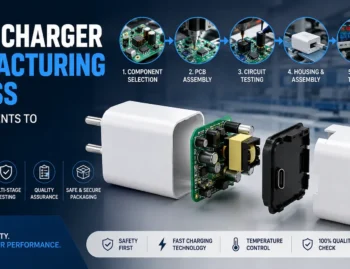
Also Read: Mobile Charger Manufacturing Process: From Components to Final Product