
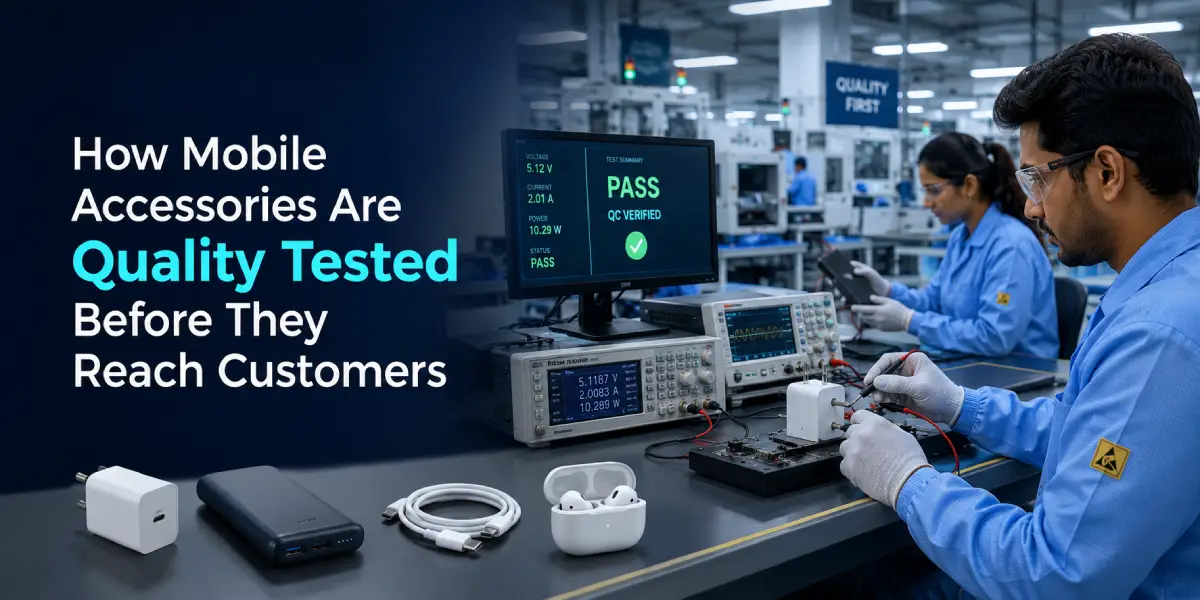
A Complete Guide to Quality Control in Mobile Accessories Manufacturing
When customers purchase a mobile charger, power bank, data cable or wireless accessory, they expect it to work reliably from the very first use. They rarely think about the extensive testing that takes place before the product reaches store shelves or online marketplaces.
Behind every high-quality mobile accessory is a carefully managed quality control process. Manufacturers don’t simply assemble products and ship them. Every stage of production—from raw material inspection to final packaging – requires multiple checks to ensure safety, performance and consistency.
For businesses working with an OEM Mobile Accessories Manufacturer, understanding how products are tested is just as important as understanding how they are manufactured. A well-defined testing process reduces defects, minimizes product returns and protects a brand’s reputation in the market.
In today’s competitive electronics industry, quality is no longer a differentiator. It is an expectation.
This guide explains how modern mobile accessories are tested before they reach customers and why quality control has become one of the most important parts of electronics manufacturing.
Why Quality Testing Matters in Mobile Accessories Manufacturing
A mobile accessory may look simple from the outside, but internally it consists of multiple electronic components working together. Even a minor defect in one component can affect the overall performance of the product.
Without proper testing, businesses may experience:
- Product failures
- High warranty claims
- Customer complaints
- Safety risks
- Increased return rates
- Damage to brand reputation
On the other hand, manufacturers that follow structured quality control systems can deliver products that offer consistent performance across every production batch.
For brands, quality testing is not an additional process—it is an investment in customer satisfaction and long-term business growth.
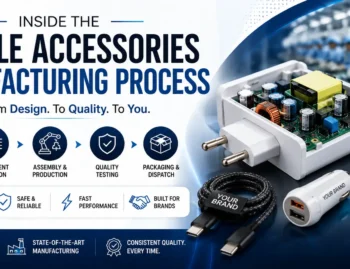
Also Read: Inside the Mobile Accessories Manufacturing Process
Understanding the Quality Control Process
Quality testing does not happen only after production is complete.
Professional manufacturers implement quality checks throughout the manufacturing cycle.
The process generally includes:
- Raw material inspection
- Component testing
- In-process quality checks
- Product performance testing
- Safety verification
- Final inspection
- Packaging verification
Each stage helps identify potential issues before products move to the next phase of production.
This systematic approach significantly reduces manufacturing defects while improving overall product consistency.
Stage 1: Incoming Raw Material Inspection
Quality begins long before the first product is assembled.
Every electronic accessory is made from multiple components, including PCBs, battery cells, connectors, wires, charging ICs, plastic housings and packaging materials.
Before production starts, manufacturers inspect incoming materials to ensure they meet predefined quality standards.
During this stage, quality teams verify:
- Material specifications
- Component dimensions
- Visual defects
- Electrical properties
- Supplier consistency
Rejecting substandard materials at this stage prevents quality issues later in the production process.
This first checkpoint lays the foundation for reliable manufacturing.
Stage 2: PCB and Electronic Component Testing
For products such as mobile chargers and power banks, the Printed Circuit Board (PCB) acts as the control center.
Even if external materials look perfect, poor PCB performance can affect charging efficiency, safety and product lifespan.
Manufacturers perform detailed inspections before PCB assembly begins.
Typical evaluations include:
Electrical Performance
Engineers verify that electronic circuits perform according to design specifications.
Component Placement
Automated systems check whether electronic components are accurately positioned.
Solder Joint Inspection
Proper soldering ensures stable electrical connections and reduces long-term failures.
Functional Verification
Basic functionality tests confirm that the PCB responds correctly before final assembly.
By identifying issues early, manufacturers reduce production waste and improve consistency across every unit.
Stage 3: Charger Performance Testing
Mobile chargers are among the most frequently used accessories, making consistent performance and safety essential.
Once chargers are assembled, they undergo several performance evaluations before packaging.
Common charger tests include:
Output Voltage Test
Engineers verify that the charger delivers the correct voltage under different operating conditions.
Stable voltage protects connected devices from damage.
Current Output Test
Current output is measured to ensure the charger performs according to its rated specifications.
This test also helps validate fast charging compatibility.
Fast Charging Compatibility
Chargers supporting technologies such as Power Delivery (PD) or Quick Charge (QC) are tested with compatible devices to verify proper protocol communication and charging efficiency.
Heat Performance Test
Continuous charging generates heat.
Manufacturers monitor operating temperatures to ensure chargers remain within safe limits during extended use.
Effective heat management improves both product safety and lifespan.
Also Read: What Makes a High-Quality Mobile Charger?
Stage 4: Power Bank Quality Testing
Power banks require even more comprehensive testing because they store and deliver electrical energy.
Manufacturers evaluate both battery performance and charging functionality before products move to final inspection.
Key tests include:
Battery Capacity Verification
The actual battery capacity is measured to confirm it matches the product specifications.
Accurate capacity improves customer confidence and product reliability.
Charging and Discharging Cycles
Power banks are tested through multiple charging and discharging cycles to evaluate battery performance over repeated usage.
This helps identify potential degradation before products reach customers.
Protection Circuit Testing
Safety systems are verified to ensure proper operation during:
- Overcharging
- Over-discharging
- Short circuits
- Excessive current flow
These protection systems play a critical role in product safety.
Temperature Monitoring
Battery temperature is monitored throughout charging and discharging processes.
Maintaining stable operating temperatures helps improve battery life and overall safety.
Also Read: Power Bank Manufacturing & Quality Guide
Stage 5: Data Cable Testing
Although data cables appear simple, they must withstand continuous daily use while maintaining reliable charging and data transfer performance.
Manufacturers evaluate several performance parameters before approving production batches.
Charging Performance Test
Data cables are tested to ensure stable power delivery without excessive voltage loss.
Data Transfer Speed
For USB data cables, transfer speed is verified to ensure reliable communication between connected devices.
Connector Strength Test
Connector durability is evaluated through repeated insertion and removal cycles.
This helps ensure long-term reliability.
Bend and Flex Test
One of the most important cable tests involves repeated bending.
The cable is flexed thousands of times under controlled conditions to evaluate:
- Internal wire strength
- Connector durability
- Outer jacket flexibility
This test helps predict long-term performance under everyday usage.
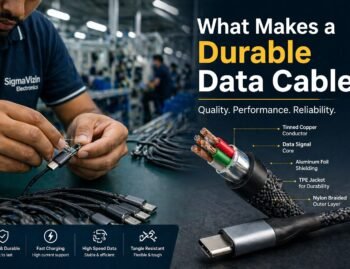
Also Read: What Makes a Durable High-Quality Data Cable?
Stage 6: Drop and Durability Testing
Mobile accessories are frequently carried in bags, pockets and vehicles, making them vulnerable to accidental drops and everyday wear. A product that performs well in the laboratory but fails during regular use cannot build customer confidence.
To evaluate durability, manufacturers perform controlled tests that simulate real-world handling conditions.
Drop Testing
Products such as chargers and power banks are dropped from predefined heights onto hard surfaces to evaluate their structural integrity.
These tests help identify:
- Housing cracks
- Loose internal components
- Connector damage
- Performance issues after impact
A well-designed product should continue functioning normally even after minor accidental drops.
Connector Life Testing
USB connectors experience repeated insertion and removal throughout their lifespan.
Manufacturers perform insertion cycle tests to evaluate:
- Connector strength
- Contact stability
- Mechanical wear
- Long-term reliability
This helps ensure consistent performance after extended usage.
Cable Flexibility Testing
For USB data cables, flexibility is just as important as charging performance.
Automated testing machines repeatedly bend and twist cables thousands of times to verify:
- Wire durability
- Connector stability
- Jacket strength
- Overall lifespan
These tests help manufacturers identify weaknesses before products reach customers.
Stage 7: Environmental and Temperature Testing
Electronic accessories operate in different environments, from air-conditioned offices to hot vehicles and humid outdoor conditions.
To ensure consistent performance, manufacturers test products under varying environmental conditions.
High Temperature Testing
Products are operated at elevated temperatures to evaluate:
- Charging stability
- Component performance
- Heat management
- Product safety
Low Temperature Testing
Cold environments can also affect electronic components.
Testing ensures products continue to operate efficiently under lower temperature conditions.
Humidity Testing
Humidity can affect internal circuits and electronic components over time.
Controlled humidity testing helps verify long-term reliability in different climates.
Stage 8: Electrical Safety Testing
Safety is one of the most important aspects of mobile accessories manufacturing.
A quality product should not only perform well but also protect the connected device and the user.
Manufacturers perform multiple safety evaluations before products are approved.
Short Circuit Protection
Products are tested to verify that internal protection systems respond correctly during abnormal electrical conditions.
Overcurrent Protection
Charging accessories are tested to ensure excessive current does not damage connected devices.
Overvoltage Protection
Voltage regulation is verified to prevent unstable power delivery.
Thermal Protection
Products are monitored during extended operation to confirm that temperature protection systems function correctly.
Reliable safety systems significantly reduce operational risks while improving customer confidence.
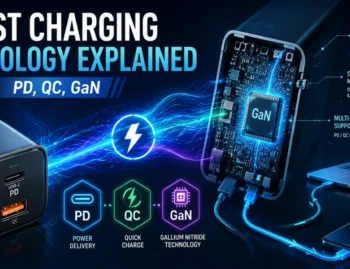
Also Read: Difference Between GaN, VOOC, PD & QC Chargers — And Which One Is Best for Your Phone
Stage 9: Final Product Inspection
Before products move to packaging, every production batch undergoes a comprehensive inspection.
Quality control teams verify:
- Product appearance
- Functional performance
- Charging capability
- Connector alignment
- Surface finish
- Label accuracy
Products that fail inspection are separated for further evaluation rather than moving to shipment.
This final verification helps maintain consistency across every production batch.
Stage 10: Packaging Quality Verification
Quality control does not end with the product itself.
Packaging also plays an important role in protecting products during storage and transportation.
Manufacturers inspect:
- Packaging quality
- Product placement
- Printed information
- User manuals
- Barcode accuracy
- Label consistency
Proper packaging reduces transit damage while improving the customer experience.
Why Businesses Trust SigmaVizin’s Quality Control Process
Reliable manufacturing is built on consistency and consistency is achieved through disciplined quality control.
SigmaVizin Electronics Pvt. Ltd. follows a structured quality-focused manufacturing approach designed to support brands that value performance, reliability and long-term product consistency.
Quality checks are integrated throughout the manufacturing process rather than being limited to the final inspection stage. From incoming material verification and production monitoring to functional testing and final product evaluation, every stage is designed to help maintain consistent standards across production batches.
As an OEM Mobile Accessories Manufacturer in India, SigmaVizin supports brands with quality-driven manufacturing across categories including mobile chargers, power banks, data cables, TWS earbuds and other electronic accessories.
For businesses, working with a manufacturing partner that prioritizes quality testing helps reduce product returns, improve customer satisfaction and strengthen brand reputation over time.
Why Quality Testing Is Important for Every Brand
Whether a business sells products online, through retail stores, or in bulk, product quality directly influences customer perception.
Consistent testing helps brands:
- Reduce warranty claims
- Improve customer satisfaction
- Build long-term trust
- Minimize product recalls
- Maintain consistent product performance
- Strengthen market reputation
For growing brands, quality control is not simply part of manufacturing—it is an essential business strategy.
Future of Quality Testing in Mobile Accessories Manufacturing
Electronics manufacturing continues to evolve with advancements in automation and intelligent testing systems.
Modern production facilities are increasingly adopting:
- Automated inspection equipment
- AI-assisted defect detection
- Digital quality monitoring
- Smart testing systems
- Real-time production analytics
These technologies improve manufacturing accuracy while reducing human error.
As the mobile accessories industry continues to grow, quality testing will become even more important for manufacturers aiming to deliver reliable products at scale.
Also Read: How to Choose the Right OEM Mobile Accessories Manufacturer in India
Final Thoughts
Every reliable mobile accessory undergoes far more than simple assembly before reaching customers.
From raw material inspection and PCB validation to durability testing, electrical safety evaluation and final product inspection, each stage plays an important role in ensuring product performance and reliability.
For businesses, understanding the quality testing process helps in selecting the right manufacturing partner and building products that customers can trust.
Manufacturers that invest in structured quality control systems not only produce better products but also help brands create stronger reputations in increasingly competitive markets.
Frequently Asked Questions
Why is quality testing important in mobile accessories manufacturing?
Quality testing helps ensure products meet performance, safety and durability standards before they reach customers, reducing defects and improving customer satisfaction.
What tests are performed on mobile chargers and power banks?
Manufacturers typically conduct voltage testing, current testing, battery performance evaluation, temperature monitoring, short circuit protection testing and functional inspections.
How are data cables tested for durability?
Data cables undergo charging performance tests, data transfer verification, connector life testing and repeated bend tests to evaluate long-term durability.
How does SigmaVizin ensure product quality?
SigmaVizin Electronics follows a structured quality control process that includes material inspection, in-process quality checks, functional testing, safety verification and final product inspection before dispatch.
Can OEM manufacturers customize testing requirements?
Yes. Experienced manufacturers such as SigmaVizin Electronics can support product-specific quality requirements based on customer specifications and industry standards.
Why should brands choose manufacturers with strong quality control systems?
A manufacturer with well-defined quality processes helps ensure consistent product performance, reduces product returns and supports long-term brand credibility.