
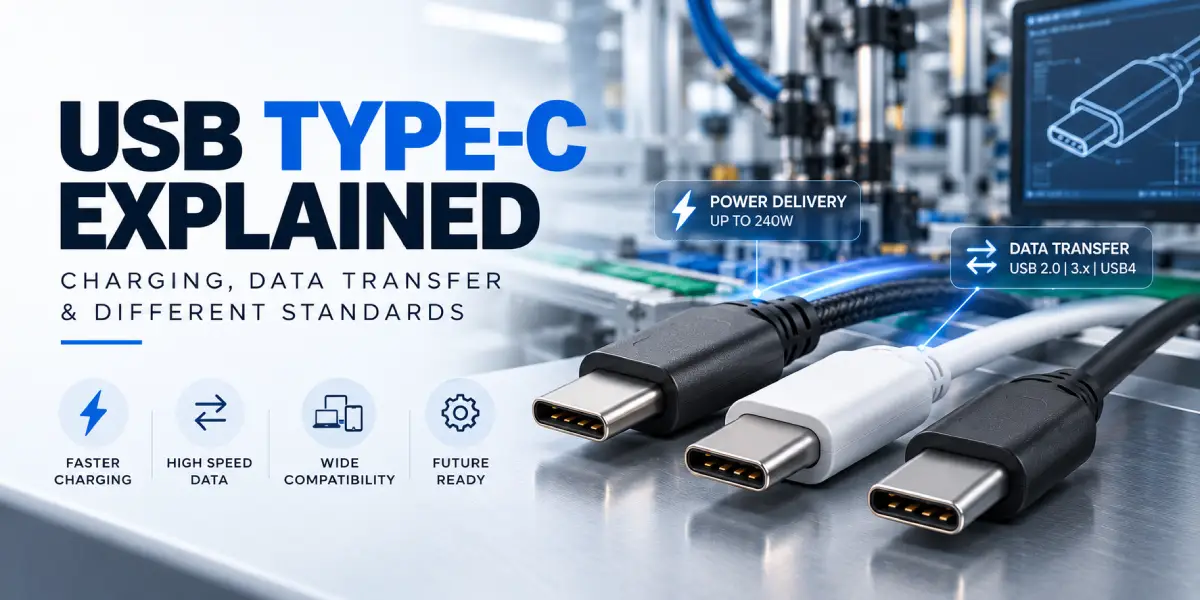
USB Type-C has quickly become one of the most common connector formats in modern consumer electronics. Smartphones, tablets, laptops, power banks, chargers, headphones, gaming devices, and other accessories increasingly use USB-C for charging, connectivity, or data transfer.
However, USB Type-C is a connector design – not a guarantee of a particular charging speed or data-transfer speed. Two cables may look almost identical while supporting very different performance levels.
For brands developing chargers, data cables, power banks, or other electronic accessories, understanding these differences is important when defining product specifications and selecting the right manufacturing partner.
This guide explains how USB Type-C works, how charging and data standards differ, and what brands should consider when developing USB-C products.
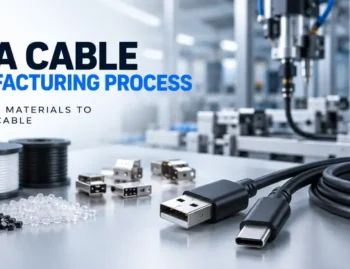
Also Read: Data Cable Manufacturing Process: From Raw Materials to Finished Cable
What Is USB Type-C?
USB Type-C, commonly called USB-C, is a reversible connector and cable interface designed to support a wide range of USB applications.
Unlike older USB connectors that required a specific orientation, the Type-C connector can be inserted either way.
But the connector itself does not determine the complete performance of the product.
A USB-C product can support different combinations of:
- Charging power
- Data-transfer speed
- USB protocols
- Display connectivity
- Power Delivery
- Other supported functions
This is why simply seeing a USB-C port does not tell you whether a device or cable supports fast charging, high-speed data, or USB4.
USB-IF’s specifications treat USB Type-C, USB Power Delivery, and USB data technologies as related but distinct parts of the USB ecosystem. Ref. – USB Implementers Forum
USB Type-C vs USB Standard
One of the most common misunderstandings is treating USB-C and USB speed as the same thing.
They are not.
USB Type-C
Refers primarily to the connector and cable interface.
USB 2.0 / USB 3.x / USB4
These refer to different USB technology and performance capabilities.
USB Power Delivery
This is a separate power-delivery protocol that allows compatible products to negotiate power over USB Type-C.
Therefore, a USB-C cable can have a USB-C connector while offering different levels of charging and data performance depending on its design.
This distinction is particularly important for brands because product packaging and specifications should clearly communicate what the product actually supports.
How USB Type-C Charging Works
USB-C has become particularly popular because it can support both power and data through the same connection.
When a compatible charger, cable, and device are connected, they can determine the appropriate power configuration supported by the system.
For higher-power applications, USB Power Delivery (USB PD) enables flexible power negotiation between compatible devices.
USB-IF describes USB PD as a technology that allows more flexible power delivery while supporting data over a USB connection. Ref. – USB Implementers Forum
This means a USB-C charger does not simply send maximum available power to every connected device.
Instead, the system can negotiate an appropriate power level based on the capabilities of the charger, cable, and connected device.
What Is USB Power Delivery?
USB Power Delivery, commonly called USB PD, is a power-management protocol used with compatible USB systems.
It allows compatible devices to negotiate power requirements rather than relying on a single fixed output.
USB PD can support a wide range of applications, from smartphones and earbuds to tablets and laptops.
The current USB PD specification has evolved considerably. USB-IF’s PD 3.1 specification expanded the USB PD power range up to 240W when used with appropriate USB Type-C implementations and cables. Ref. – USB Implementers Forum
This does not mean every USB-C cable or charger supports 240W.
The actual capability depends on the complete system and the specifications of the charger, cable, connector, and device.
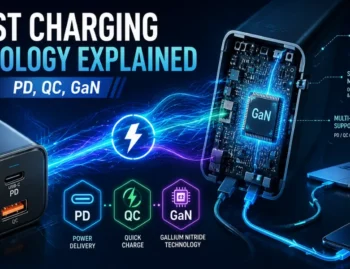
Also Read: Fast Charging Technology Explained for Brands (PD, QC, GaN)
USB-C Charging Speed: What Brands Need to Understand
One of the biggest marketing mistakes brands can make is treating USB-C as synonymous with fast charging.
A USB-C connector alone does not guarantee fast charging.
Charging performance depends on several factors, including:
- Charger output
- Supported charging protocol
- Cable capability
- Device requirements
- Power-management system
- Connector and cable design
For example, a USB-C cable may physically connect a smartphone to a charger but still have limitations in power or data performance.
This is why brands should define the complete charging specification rather than simply describing a product as a “USB-C cable.”
USB-C Data Transfer
USB Type-C can also support data transfer, but the available speed depends on the USB technology implemented in the product.
Different USB generations and implementations can offer significantly different data capabilities.
A cable designed primarily for basic USB 2.0 communication is not equivalent to a high-speed USB4 cable simply because both use USB-C connectors.
USB-IF specifically separates the physical Type-C interface from USB performance specifications. Ref. – USB Implementers Forum
For brands, this distinction is important when creating:
- Product specifications
- Packaging
- Product listings
- Technical datasheets
- Marketing claims
The advertised data performance should accurately reflect the cable’s tested capabilities.
USB 2.0 vs USB 3.x vs USB4
The USB ecosystem includes multiple generations and performance levels.
USB 2.0
USB 2.0 is an older but still widely used USB technology.
It can be suitable for products where basic data communication and charging are the primary requirements.
Many affordable USB-C cables can use a USB 2.0 data implementation while still using the modern USB-C connector.
Therefore:
USB-C does not automatically mean high-speed data.
USB 3.x
USB 3.x technologies provide higher data-transfer capabilities than USB 2.0.
Depending on the specific implementation, products may support different performance levels.
For brands, it is therefore better to specify the actual supported USB data rate instead of using a vague term such as “high-speed” without supporting details.
USB4
USB4 represents a more advanced USB architecture designed for higher-bandwidth applications.
USB-IF states that USB4 can support up to 80 Gbps operation over certified 80 Gbps cables, with support for multiple data and display protocols. Ref. – USB Implementers Forum
USB4 is therefore significantly more sophisticated than a basic USB 2.0 implementation.
However, USB4 should not be confused with USB Type-C itself.
USB-IF explicitly notes that USB4, USB Type-C, and USB Power Delivery are separate technologies with different roles. Ref. – USB Implementers Forum
Why the Cable Matters
A common misconception is that the charger and smartphone determine all charging and data performance.
The cable can also be a limiting factor.
A cable needs to be designed for the intended electrical and data requirements.
Important cable characteristics can include:
- Conductor design
- Wire configuration
- Connector quality
- Current capability
- Data capability
- Shielding
- Cable length
- Signal integrity
- Thermal performance
This is particularly important for high-power and high-speed USB-C products.
USB-IF’s cable compliance documentation includes separate requirements for USB Type-C cable and connector compliance, with additional testing requirements for products supporting USB Power Delivery. Ref. – USB Implementers Forum
What Is an E-Marker?
Some USB-C cables use an E-Marker, an electronic component that can communicate information about the cable’s capabilities to the connected USB system.
E-Marker implementation becomes particularly relevant for certain higher-capability USB-C cables.
It can help the system identify supported characteristics such as power and data capabilities.
This is one reason why two visually similar USB-C cables can have very different technical capabilities internally.
For manufacturers and brands, the cable architecture needs to match the intended product specification rather than relying solely on the appearance of the connector.
USB-IF specifically references E-Marker implementation in its USB Type-C cable compliance and USB Power Delivery testing documentation. Ref. – USB Implementers Forum
USB-C Cable Power Ratings
For USB-C to USB-C cables, power capability has become an important specification.
USB-IF’s current cable guidance uses 60W and 240W power markings for compliant USB-C to USB-C cable categories, with additional data-rate markings for applicable higher-speed cables. Ref. – USB Implementers Forum
This is useful for consumers because the connector alone does not communicate the cable’s full capability.
For brands, clearly defining cable power and data capabilities can reduce confusion and help customers select the correct product.
Why USB-C Is Important for Mobile Accessories Brands
USB-C has changed the way manufacturers approach chargers and cables.
A modern accessory portfolio may include:
- USB-C to USB-C cables
- USB-A to USB-C cables
- USB-C chargers
- USB-C power banks
- USB-C hubs
- USB-C audio accessories
- USB-C enabled consumer electronics
For brands, this creates opportunities to build product ranges around different charging power levels, data capabilities, lengths, materials and target customers.
However, technical specifications need to be clearly defined before manufacturing begins.
Also Read: What Makes a Durable High-Quality Data Cable?
How to Choose the Right USB C Cable for Different Products
Not every USB C cable is designed for the same purpose. A cable used for a basic charging accessory may have very different requirements from one designed for a laptop, power bank, smartphone, monitor, or high speed data device.
For brands developing USB C products, cable selection should begin with the product requirement rather than simply choosing the cheapest or highest rated cable available.
The main factors to consider include:
• Required charging power
• Supported data transfer speed
• Cable length
• Connector type
• Device compatibility
• Cable construction
• Temperature and durability requirements
• Required certifications and compliance
For example, a cable intended for a standard charging accessory may not need the same data capability as a cable designed for high speed storage or professional devices.
Similarly, a cable supporting higher power delivery needs to be designed and tested for that power level. USB C itself does not automatically mean that a cable supports high wattage or high speed data.
This distinction is particularly important for brands selling products under their own name.
USB C Cable Quality: What Actually Matters?
The appearance of a USB C cable can be misleading. Two cables may look almost identical from the outside while having significantly different electrical and performance characteristics.
For manufacturers and brands, cable quality should therefore be evaluated beyond the outer material.
1. Conductors and Internal Construction
The internal conductors influence charging performance, resistance, heat generation, and data transmission.
Cable construction should be selected according to the intended power and data requirements of the product.
2. Connector Quality
USB C connectors experience repeated insertion and removal during normal use. Poor quality connectors can result in loose connections, inconsistent charging, or premature failure.
Mechanical durability is therefore an important part of cable development.
3. Power Capability
A cable should be capable of safely handling the power level it is designed to support.
USB C cables can have different power capabilities, and USB Power Delivery can support substantially higher power levels when the complete system, including the charger, device, and cable, supports the required specification. USB PD has evolved to support power levels up to 240W in appropriate implementations.
4. Data Capability
A charging cable and a high speed data cable are not necessarily the same.
Depending on the implementation, USB C products can support USB 2.0, USB 3.x, USB4, and other capabilities. USB4 can support very high bandwidth, but the actual capability depends on the devices, ports, and cable involved.
5. Insulation and Outer Material
The outer jacket protects the internal conductors and affects flexibility, durability, and resistance to everyday wear.
For consumer products, brands often need to balance flexibility with durability because extremely stiff cables can be inconvenient while very soft constructions may not provide sufficient protection.
Charging Cable vs Data Cable: What Is the Difference?
One of the most common misunderstandings surrounding USB C is that every USB C cable automatically supports fast data transfer.
That is not the case.
USB C describes the connector and connection system. The actual capabilities of a cable depend on its internal design and the applicable USB specifications.
A USB C cable may primarily be designed for charging, while another may support both charging and high speed data transfer.
For brands, this means the cable specification should be matched to the product instead of relying only on the connector shape.
Example
Consider two products:
Product A: A basic power bank intended primarily for charging smartphones.
Product B: A high speed storage device that requires fast data transfer.
Both products may use USB C connectors, but their cable requirements can be very different.
Product A may prioritize charging capability, durability and compatibility.
Product B may require substantially higher data performance in addition to suitable power handling.
This is why product development teams should define charging and data requirements before finalizing the cable design.
Understanding USB C Cable Testing
Testing is an important part of USB C product development because cable performance cannot always be determined through visual inspection.
Depending on the product and target specification, manufacturers may evaluate several areas.
Electrical Testing
Electrical tests can help verify continuity, resistance, connectivity, and other electrical characteristics.
These checks help identify problems such as poor connections, excessive resistance, or inconsistent electrical performance.
Charging Performance Testing
Where a cable is intended for charging, its performance can be evaluated under the expected operating conditions.
Testing can help determine whether the cable performs consistently at its intended power level and whether abnormal heat or electrical behaviour occurs.
Data Transfer Testing
For data capable cables, testing can verify whether the intended data performance is achieved.
This becomes increasingly important for USB 3.x and USB4 applications where signal integrity and high speed performance are more demanding.
Mechanical Testing
USB C connectors are repeatedly connected and disconnected during everyday use.
Mechanical testing can therefore evaluate connector durability and the ability of the cable assembly to withstand repeated use.
Thermal Testing
Higher power applications can generate more heat. Thermal evaluation can help manufacturers understand cable behavior under expected operating conditions.
The exact testing requirements depend on the product, design, target market, and applicable standards.
Also Read: How Mobile Accessories Are Quality Tested Before They Reach Customers
Common USB C Mistakes Brands Should Avoid
Brands entering the electronics market can make several mistakes when developing USB C products.
Mistake 1: Assuming Every USB C Cable Supports Fast Charging
USB C does not automatically guarantee fast charging.
The charger, device, cable, charging protocol, and power requirements all influence the final charging experience.
Mistake 2: Treating USB C as a Speed Standard
USB C is the connector interface. USB 2.0, USB 3.x, USB4 and other technologies define different levels of capability.
A USB C connector alone does not tell the customer how fast data can be transferred.
Mistake 3: Choosing a Cable Only by Appearance
A premium looking cable may still have limitations in power handling or data performance.
Brands should evaluate the technical specifications and testing requirements before finalizing the product.
Mistake 4: Ignoring Cable Length
Cable length can influence practical performance, especially in higher speed applications.
The cable should therefore be selected according to the intended use rather than treating length as purely a design decision.
Mistake 5: Using the Same Cable Across Every Product
A cable suitable for a basic charging product may not be suitable for a high power or high speed data product.
Different product categories may require different cable specifications.
USB C Manufacturing for OEM and Private Label Brands
For businesses launching USB C cables under their own brand, manufacturing involves much more than assembling two connectors and a wire.
The development process can include product specification, material selection, connector selection, cable construction, tooling where required, assembly, testing, packaging, and quality inspection.
The first step is usually defining the intended product.
A brand may need a standard charging cable, a high power USB C cable, a high speed data cable, a braided cable, a custom length cable, or a product developed around a specific device category.
Once the requirements are established, the manufacturer can select suitable components and define the construction.
For private label products, the external design can also be adapted to the brand’s requirements. This may include cable colour, connector finish, outer material, packaging, branding, length, and other product specifications.
For B2B brands, this approach can be useful because the product can be developed around the intended market rather than simply selecting an existing generic cable.
How SigmaVizin Supports USB C Product Manufacturing
For brands looking to develop USB C based products, SigmaVizin Electronics Pvt. Ltd. can support the product development and manufacturing process based on the required product specifications.
The focus is not simply on producing a cable. The objective is to develop a product that matches the brand’s intended application, specifications, packaging requirements and target market.
Depending on the project, this can include product customization, private label manufacturing, component selection, cable specifications, branding, packaging, testing and bulk production.
This gives businesses the flexibility to develop USB C products for different market segments while maintaining consistency across their product range.
For brands planning a new electronics product, selecting the right manufacturing partner early in the development process can also help reduce compatibility issues and unnecessary product revisions.
The Future of USB C
USB C has become an important part of modern electronics because a single connector format can support multiple applications.
Charging, data transfer, displays, peripherals, smartphones, tablets, laptops, power banks and other electronics can all use USB C, although the capabilities available through each implementation can differ.
The USB ecosystem is also continuing to evolve.
USB4 introduces higher bandwidth and improved protocol support, while USB Power Delivery continues to expand the power capabilities available through USB C connections.
For electronics brands, this means USB C product development will increasingly require attention to the complete system rather than only the connector.
The cable, charger, device, power requirements, data requirements and applicable specifications all need to work together.
What This Means for Electronics Brands
The biggest lesson is simple: USB C is more than a connector.
For brands, understanding the differences between USB C, USB 2.0, USB 3.x, USB4 and USB Power Delivery can help avoid incorrect product specifications and customer expectations.
When developing a USB C product, businesses should clearly define:
• Charging requirements
• Data transfer requirements
• Cable power rating
• Connector requirements
• Cable length
• Material and durability
• Compatibility requirements
• Testing requirements
• Packaging and branding requirements
This approach makes product development more structured and reduces the risk of choosing components that do not match the final product.
Also Read: How Mobile Accessories Are Quality Tested Before They Reach Customers
Final Thoughts
USB C has changed the way modern electronics handle charging and connectivity, but its flexibility also makes the technology more complex than it appears.
The same USB C connector can be used across products with very different charging, data, and performance capabilities.
For electronics brands, understanding these differences is important when developing products, selecting components, creating specifications, and communicating product capabilities to customers.
Whether the goal is a standard charging cable, high power cable, high speed data cable, power bank, charger, or another USB C enabled product, the right approach begins with clearly defined requirements and suitable manufacturing processes.
As USB technology continues to develop, brands that understand the ecosystem will be better positioned to create products that deliver reliable performance and meet changing consumer expectations.
Frequently Asked Questions
1. Is every USB C cable a fast charging cable?
No. USB C describes the connector system, but charging performance depends on the cable’s capabilities along with the charger, device, and supported charging technology.
2. Does USB C always mean high speed data transfer?
No. USB C products can support different data capabilities. A USB C connector does not by itself guarantee USB 3.x or USB4 performance.
3. Can businesses get custom USB C cables manufactured?
Yes. Brands can develop USB C cables with customized specifications such as length, materials, connector design, colour, branding, packaging and intended power or data capability, depending on the manufacturing requirements.
4. Can SigmaVizin manufacture USB C cables for brands?
Yes. SigmaVizin supports electronics product manufacturing for businesses, including customized and private label product development based on defined product specifications and requirements.
5. What should brands check before selecting a USB C cable manufacturer?
Brands should evaluate manufacturing capability, product specifications, component quality, testing processes, customization options, quality control, compliance requirements, packaging support, and the manufacturer’s ability to handle the required production volume.
6. Why is USB C important for electronics brands?
USB C provides a widely adopted connector format that can support charging, data transfer and other connectivity applications. Its broad use across modern electronics makes it an important consideration for brands developing chargers, cables, power banks and other connected devices.